Tuesday, May 1, 2018
Women Representation in Statues
Alexandra Topping in the Guardian writes on Tue 24 Apr 2018 "First statue of a woman in Parliament Square unveiled" about the lack of female statues in Parliament Square in London, that was changed just recently "...when a 8ft 4in bronze statue of the suffragist campaigner Millicent Fawcett was unveiled in the shadow of the Houses of Parliament"
"Speaking at a formal unveiling of the statue, she (Criado-Perez) said: “Women are still woefully underrepresented in all areas of British cultural and political life , not least in its statues.” Pointing out that less than 3% of statues in Britain depict real, non-royal women, she added: “With this statue of Millicent Fawcett, the first statue of a woman, and the first statue by a woman, in this iconic location, we’re making one hell of a start on changing that.”"

Tuesday, December 20, 2016
Affirmative Action in the UK movie Industry
The BAFTA awards implement Affirmative Action: According to an article by Aisha Harris, "Starting in 2019, If Your Film Isn’t Diverse, It Won’t Be Eligible for a BAFTA Award".
The article says:
"In an incredibly bold move, the British Academy of Film and Television Arts announced last week that, beginning in 2019,works that do not demonstrate inclusivity in their production practices will no longer be eligible for its annual awards, the BAFTAs, often considered the U.K. equivalent of the Oscars. Eligible projects must showcase this in two of the following ways, as the BBC reported: On screen characters and themes, senior roles and crew, industry training and career progression, and audience access and appeal to underrepresented audiences. BAFTA will also remove the requirement that newly admitted voters be recommended by two existing members."
The BBC states:
"To be eligible for the two awards, films must prove they have worked to improve diversity in two of the four following areas:
The measures comply with the diversity standards the BFI (British Film Institute) uses to guide its activities and the projects it funds. The changes show Bafta's determination "in increasing the representation of under-represented groups in front of and behind the camera", a statement said."
I am looking forward to Econ JM papers 5-10 years from now...
The article says:
"In an incredibly bold move, the British Academy of Film and Television Arts announced last week that, beginning in 2019,works that do not demonstrate inclusivity in their production practices will no longer be eligible for its annual awards, the BAFTAs, often considered the U.K. equivalent of the Oscars. Eligible projects must showcase this in two of the following ways, as the BBC reported: On screen characters and themes, senior roles and crew, industry training and career progression, and audience access and appeal to underrepresented audiences. BAFTA will also remove the requirement that newly admitted voters be recommended by two existing members."
The BBC states:
"To be eligible for the two awards, films must prove they have worked to improve diversity in two of the four following areas:
- On-screen characters and themes
- Senior roles and crew
- Industry training and career progression
- Audience access and appeal to under-represented audiences
The measures comply with the diversity standards the BFI (British Film Institute) uses to guide its activities and the projects it funds. The changes show Bafta's determination "in increasing the representation of under-represented groups in front of and behind the camera", a statement said."
I am looking forward to Econ JM papers 5-10 years from now...
Monday, December 19, 2016
Women and Elections: Austria Edition, again
Since Thursday we have the final result of the second election of President. Of the 6.399.607 who are eligible to vote, 4.749.339 voted, of which 4.597.553 votes are allowable. Van der Bellen received 2.472.892 votes, that is 53,79 Prozent. Hofer received 2.124.661 votes, so 46,21 Prozent. 74,2 of eligible people voted (see DerStandard)
Like last time, Van der Bellen came is an an independent, but was the former head of the green party. For the economists, he has an Econometrica.
Who voted for him this second time, after the result of the first election were annulled?


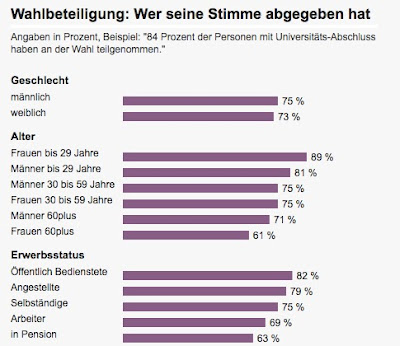

Like last time, Van der Bellen came is an an independent, but was the former head of the green party. For the economists, he has an Econometrica.
Who voted for him this second time, after the result of the first election were annulled?

Tuesday, November 8, 2016
Gender and Election: USA edition
I wrote happily how women in Austria changed the election here. Turns out, we need to vote gain, as not all went as it should have (though there was no evidence of fraud, just of improper timing of opening ballots).
As it seems, the US seems to be in a more extreme version of a political gender divide:


This is more than a week old though, I'll be curious how this looks later today....
As it seems, the US seems to be in a more extreme version of a political gender divide:
This is more than a week old though, I'll be curious how this looks later today....
Monday, November 7, 2016
Diversity in Economics
A new article in JEP "Diversity in the Economics Profession: A New Attack on an Old Problem", by Amanda Bayer and Cecilia Elena Rouse.
The article starts with " In the United States, of 500 doctorate degrees awarded in economics to US citizens and permanent residents in 2014, only 42 were awarded to African Americans, Hispanics, and Native Americans and 157 to women (although this double-counts the 11 minority women who earned economics doctorates in 2014). "
There are about 1100 students who receive their PhD in the US (see NSF report) of which about 33.4 are female, about the same percentage as for US citizens and residents.
It seems that Econ is doing much worse than many other fields (see Figure 1 from their paper below, where Economics (E), Humanities (H), Social Science (SS) Business (B) STEM (STEM)

The article starts with " In the United States, of 500 doctorate degrees awarded in economics to US citizens and permanent residents in 2014, only 42 were awarded to African Americans, Hispanics, and Native Americans and 157 to women (although this double-counts the 11 minority women who earned economics doctorates in 2014). "
There are about 1100 students who receive their PhD in the US (see NSF report) of which about 33.4 are female, about the same percentage as for US citizens and residents.
It seems that Econ is doing much worse than many other fields (see Figure 1 from their paper below, where Economics (E), Humanities (H), Social Science (SS) Business (B) STEM (STEM)
Thinking about why women are not becoming economists, they write:
Performance in early economics courses—such as introductory courses—and
especially relative to performance in other courses may also be related to the decision
to persist in economics. Rask and Tiefenthaler (2008), using 16 years of data
from a liberal arts college where economics is a prominent major, find that women
are more responsive to their relative grades in economics than are men. Of course, if
this response exists across economics departments, it is likely related to the specific
context of economics, including advising practices: if women were universally more
responsive to relative grades, then they would also be more averse to majoring in
math and science, where grades tend to be low (for example, see Butcher, McEwan,
and Weerapana 2014, in this journal), but where female representation is higher
than in economics."
Being economists, they also have a section on why it may matter why there are no women and minorities.
They write:
"First, opinions among economists about policy are not the same across different groups. In a survey of 143 AEA members with doctoral degrees from US institutions, May, McGarvey, and Whaples (2014) find that male and female economists have different views on economic outcomes and policies, even after controlling for vintage of PhD and type of employment. For example, relative to male economists, women economists are 21 percentage points more likely to disagree that the United States has excessive government regulation of economic activity; 32 percentage points more likely to agree with making the distribution of income more equal; 30 percentage points more likely to agree that the United States should link import openness to labor standards; and 42 percentage points more likely to disagree that labor market opportunities are equal for men and women."
Thursday, October 13, 2016
New Handbook of Experimental Economics
The new (vol 2 of the) Handbook of Experimental Economics, Eds John Kagel and Alvin Roth, came out!
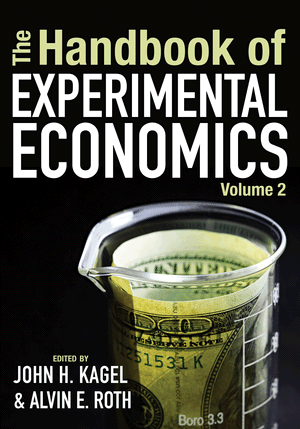
The chapters are:
The chapters are:
- Chapter 1 Macroeconomics: A Survey of Laboratory Research, John Duffy
- Chapter 2 Using Experimental Methods to Understand Why and How We Give to Charity, Lise Vesterlund
- Chapter 3 Neuroeconomics, Colin F. Camerer, Jonathan D. Cohen, Ernst Fehr, Paul W. Glimcher, and David Laibson
- Chapter 4 Other-Regarding Preferences: A Selective Survey of Experimental Results, David J. Cooper and John H. Kagel
- Chapter 5 Experiments in Market Design, Alvin E. Roth
- Chapter 6 Experiments in Political Economy, Thomas R. Palfrey
- Chapter 7 Experimental Economics across Subject Populations, Guillaume R. Fréchette
- Chapter 8 Gender, Muriel Niederle
- Chapter 9 Auctions: A Survey of Experimental Research, John H. Kagel and Dan Levin
- Chapter 10 Learning and the Economics of Small Decisions, Ido Erev and Ernan Haruvy
Tuesday, October 11, 2016
Replication
Andrew Gelman writes in Slate on the Replication Crisis: "Why Does the Replication Crisis Seem Worse in Psychology?"
The article begins with
"Last week, the replication crisis in psychology was pushed back into the news when Susan Fiske, a former president of the Association for Psychological Science, wrote a column in which she criticized “online vigilantes” on blogs, Twitter, and Facebook who have taken prominent work in social psychology to task. Fiske likened these “destructo-critics” to “methodological terrorists.” "
He then asks:
Why does psychology continue to dominate the news when it comes to discussion of the replication crisis?
Why not economics, which is more controversial and gets more space in the news media? Or medicine, which has higher stakes and a regular flow of well-publicized scandals?
He has 5 explanations (abbreviated here)
1. Sophistication: "..psychology is an inherently difficult field, studying constructs such as personality, intelligence, and motivation, which are undeniably important but which by their nature are “latent constructs” that cannot be measured directly."
2. Overconfidence deriving from research designs: When we talk about the replication crisis in psychology, we’re mostly talking about lab experiments and surveys. Either way, you get clean identification of comparisons, hence there’s an assumption that simple textbook methods can’t go wrong.
3. Openness. ..In psychology, it’s relatively easy to get your hands on the data or at least to find mistakes in published work.
4. Involvement of some of prominent academics. But, in psychology, the replication crisis has engulfed Fiske, Roy Baumeister, John Bargh, Carol Dweck … these are leaders in their field. So there’s a legitimate feeling that the replication crisis strikes at the heart of psychology, or at least social psychology; it’s hard to dismiss it as a series of isolated incidents.
5. Everyone loves psychology: It’s often of general interest (hence all the press coverage, TED Talks, and so on) and accessible, both in its subject matter and its methods.
The article begins with
"Last week, the replication crisis in psychology was pushed back into the news when Susan Fiske, a former president of the Association for Psychological Science, wrote a column in which she criticized “online vigilantes” on blogs, Twitter, and Facebook who have taken prominent work in social psychology to task. Fiske likened these “destructo-critics” to “methodological terrorists.” "
He then asks:
Why does psychology continue to dominate the news when it comes to discussion of the replication crisis?
Why not economics, which is more controversial and gets more space in the news media? Or medicine, which has higher stakes and a regular flow of well-publicized scandals?
He has 5 explanations (abbreviated here)
1. Sophistication: "..psychology is an inherently difficult field, studying constructs such as personality, intelligence, and motivation, which are undeniably important but which by their nature are “latent constructs” that cannot be measured directly."
2. Overconfidence deriving from research designs: When we talk about the replication crisis in psychology, we’re mostly talking about lab experiments and surveys. Either way, you get clean identification of comparisons, hence there’s an assumption that simple textbook methods can’t go wrong.
3. Openness. ..In psychology, it’s relatively easy to get your hands on the data or at least to find mistakes in published work.
4. Involvement of some of prominent academics. But, in psychology, the replication crisis has engulfed Fiske, Roy Baumeister, John Bargh, Carol Dweck … these are leaders in their field. So there’s a legitimate feeling that the replication crisis strikes at the heart of psychology, or at least social psychology; it’s hard to dismiss it as a series of isolated incidents.
5. Everyone loves psychology: It’s often of general interest (hence all the press coverage, TED Talks, and so on) and accessible, both in its subject matter and its methods.
What do you get when you put it together?
The strengths and weaknesses of the field of research psychology seemed to have combined to (a) encourage the publication and dissemination of lots of low-quality, unreplicable research, while (b) creating the conditions for this problem to be recognized, exposed, and discussed openly."
I actually always thought that there might be another reason (though admittedly I have not fully tested that theory with psychologists). But it seems in psychology, there is a huge bonus for having your own bias or model, and people mostly don't work on other people's experiments. In economics, on the other hand, it is perfectly fine to work on extensions of others' experiments and still have a great career. Luckily for me, for example, my paper with Lise Vesterlund was replicated many times, where most of these replications, and certainly almost all that are published, are in papers that have extensions where the baseline experiment was a big part of my experiment with Lise Vesterlund.
I feel that replications are common in experimental economics, and perhaps more so than in psychology, and so this may reduce the eagerness to publish results that feel not robust, and definitely may reduce the long successful careers some psychologists enjoyed before it was found out that their papers were fraudulent.
One way to think of this, is that there might be a real need to find out how many papers in economics are "replicated" where replications should be thought of in a very broad term. Then it could be interesting to compare this to psychology papers. And an important twist might be that a replication by the same author should perhaps not get the same weight as a replication by others.
I feel that replications are common in experimental economics, and perhaps more so than in psychology, and so this may reduce the eagerness to publish results that feel not robust, and definitely may reduce the long successful careers some psychologists enjoyed before it was found out that their papers were fraudulent.
One way to think of this, is that there might be a real need to find out how many papers in economics are "replicated" where replications should be thought of in a very broad term. Then it could be interesting to compare this to psychology papers. And an important twist might be that a replication by the same author should perhaps not get the same weight as a replication by others.
Monday, May 23, 2016
Elections and women
Today, happy news, that the next Austrian president is a former colleague of mine: Alexander (Sascha) Van der Bellen... 50,35 %. 2,254,484 Stimmen fuer VdB und 2,223,458 fuer Hofer. He came is an an independent, but was the former head of the green party. For the economists, he has an Econometrica.


Slate writes: "The Austrian Version of Trump Lost His Election, but Only Just Barely"
He won all the state capitals, and here is another familiar picture: People who voted for him: Women, Educated,
Slate writes: "The Austrian Version of Trump Lost His Election, but Only Just Barely"
Monday, May 16, 2016
Grit: A review on scientific progress...
Daniel Engber at Slate writes "Is “Grit” Really the Key to Success?"
"Up in the Hudson Valley, among the plebes at Beast Barracks, Duckworth found the secret of success. Students who identified with statements such as “Setbacks don’t discourage me” and “I never give up” were more likely than their peers to make it through West Point’s seven-week test of fortitude. (That’s how grit is measured: Students assign themselves a score of 1 to 5 for each of 10 related character statements; the 10 scores are then averaged together.) This was Duckworth’s first case study, and it delivered a clear and forceful message: If you want to make it through basic training, you gotta have grit."
"Even the task of graduating from West Point itself doesn’t really compare to the trials of Beast. When Duckworth looked at students’ grades and “military performance scores” during their first year at school, she found that grit offered little guidance on how they’d handle the rest of the United States Military Academy curriculum. The whole candidate score—that old-fashioned, talent-based assessment—did much better. Considering that three-quarters of the students who fail to finish at West Point flunk during the post-Beast curriculum, those first seven gritty weeks appear to represent a special case, and one of marginal importance.
To show that the challenges of Beast stand in for those of life, Duckworth looked for grit in other settings, places where one might not expect to find endurance as a major factor in success. For one study, she surveyed 149 undergrads at the University of Pennsylvania, finding that the students’ grit and SAT scores—the latter used as a proxy for their natural aptitude—were each and independently related to their school performance as measured by their grades. Even for these brainy Ivy Leaguers, grit seemed to be just as important as intelligence. Indeed, Duckworth writes that this was one of the key findings that led her to the “fundamental insight that would guide [her] future work.”"
He then writes
"When everyone excels on one dimension—height, SAT scores—other factors will appear to play an outsize role. In the case of Duckworth’s brainy Ivy Leaguers, this makes their SATs seem less important for predicting how they’ll do in school and exaggerates the relative importance of their grit. If she’d mixed the same people in with a more balanced sample of their peers, let’s say those with average SAT scores closer to 1,000, then the link between their aptitude and grades would have appeared more pronounced—and that would in turn have made the correlation with their grit seem less impressive."
I actually don't fully agree with that, as we could still think of Grit being important when, say, admitting smart students.
"That’s long been a problem for personality psychologists, who often struggle with competing terms for common, underlying inclinations. The field had become a tangled mess by the 1950s and the 1960s, says Brent Roberts, a professor at the University of Illinois (whom Duckworth also cites). For any given outcome in a person’s life—whether he might turn out to be a drunk, let’s say, or a genius or a crook—researchers would devise a brand-new measure, calibrated to predict it. “It had a brutal elegance,” Roberts says, “and I often pine for those days, to be honest with you.”
But this rampant sowing of new ideas made it hard even for the specialists to find their way within the field. They didn’t always know how their measures related to their colleagues’ or if they might be duplicating one another’s work. By the 1980s and the 1990s, lumpers in psychology had embraced a grand unified theory of personality, which collapsed all the nuances that came before into a set of supertraits—the Big Five. Under this new system, grit and all its near and distant cousins—willpower, superego strength, industriousness, and so on—would fall under an umbrella factor known as “conscientiousness.” (The remaining four of the Big Five supertraits: extraversion, agreeableness, neuroticism, and openness to experience.) Like grit, conscientiousness could be measured with a survey: a set of statements, maybe several hundred, for a person to read and then assign himself a score. (There are other ways to measure personality: A psychologist might ask people, for example, whether they engage in specific behaviors such as making lists or showing up early for meetings.)
“[The Big Five] brought clarity to a true buzz of confusion,” Roberts says, and it allowed researchers to make bigger claims about the broad significance of character. A measure of someone’s conscientiousness, for example, could help predict her longevity and physical health, as well as her marital stability. It could also tell you how likely she would be to find success in high school, college, and the workplace. But if the adoption of the Big Five proved useful in the lab, it made the science of personality harder to explain to outsiders. “When I say, conscientiousness,” says Roberts, “people go, ‘Huh?’ ”
That’s why Duckworth worked so hard to give her measure a catchy name. “I came up with it over other terms like pluck, tenacity, persistence, perseverance,” she said during one interview. “It has the connotations that I wanted. It sounds good.” It’s true: Conscientiousness comes off as something weak—a nerdy way of playing by the rules; grit suggests a vigorous, old-fashioned form of virtue. Grit’s the antidote for an overpolished age, a return to rough-hewn authenticity. “It’s brilliant in terms of marketing,” says Roberts. “People understand it immediately.”
..
"A brand-new meta-analysis of the literature on grit—conducted by researchers Marcus Credé, Michael Tynan, and Peter Harms using 88 samples and 67,000 subjects—provides some clues.* There isn’t much space between Duckworth’s measure and conscientiousness, the study argues. If you test a group of people for both traits, administering standard surveys to measure grit and conscientiousness, the results will end up very tightly linked; in some studies their relationship approaches 1-to-1. In Roberts’ view, grit corresponds very closely to a facet, or subtrait, of conscientiousness that has for many years been called industriousness."
Tuesday, May 10, 2016
Science and Replication
A topic becomes really important when it reaches TV shows. This is just what happened with replication in science: cHeck out John Oliver's Science segment:
Check out my paper with Lucas Coffman on that topic, and my earlier post
Monday, May 9, 2016
Discrimination
Nicholas Kristof in the NYtimes writes about "A Confession of Liberal Intolerance"
"A study published in The American Journal of Political Science underscored how powerful political bias can be. In an experiment, Democrats and Republicans were asked to choose a scholarship winner from among (fictitious) finalists, with the experiment tweaked so that applicants sometimes included the president of the Democratic or Republican club, while varying the credentials and race of each. Four-fifths of Democrats and Republicans alike chose a student of their own party to win a scholarship, and discrimination against people of the other party was much greater than discrimination based on race."
The study is "Fear and Loathing across Party Lines: New Evidence on Group Polarization," by Shanto Iyengar from Stanford University and Sean J. Westwood from Princeton University
American Journal of Political Science, Vol. 59, No. 3, July 2015, Pp. 690–707
The abstract reads:
When defined in terms of social identity and affect toward copartisans and opposing partisans, the polarization of the American electorate has dramatically increased. We document the scope and consequences of affective polarization of partisans using implicit, explicit, and behavioral indicators. Our evidence demonstrates that hostile feelings for the opposing party are ingrained or automatic in voters’ minds, and that affective polarization based on party is just as strong as polarization based on race. We further show that party cues exert powerful effects on nonpolitical judgments and behaviors. Partisans discriminate against opposing partisans, doing so to a degree that exceeds discrimination based on race. We note that the willingness of partisans to display open animus for opposing partisans can be attributed to the absence of norms
governing the expression of negative sentiment and that increased partisan affect provides an incentive for elites to engage in confrontation rather than cooperation.
"A study published in The American Journal of Political Science underscored how powerful political bias can be. In an experiment, Democrats and Republicans were asked to choose a scholarship winner from among (fictitious) finalists, with the experiment tweaked so that applicants sometimes included the president of the Democratic or Republican club, while varying the credentials and race of each. Four-fifths of Democrats and Republicans alike chose a student of their own party to win a scholarship, and discrimination against people of the other party was much greater than discrimination based on race."
The study is "Fear and Loathing across Party Lines: New Evidence on Group Polarization," by Shanto Iyengar from Stanford University and Sean J. Westwood from Princeton University
American Journal of Political Science, Vol. 59, No. 3, July 2015, Pp. 690–707
The abstract reads:
When defined in terms of social identity and affect toward copartisans and opposing partisans, the polarization of the American electorate has dramatically increased. We document the scope and consequences of affective polarization of partisans using implicit, explicit, and behavioral indicators. Our evidence demonstrates that hostile feelings for the opposing party are ingrained or automatic in voters’ minds, and that affective polarization based on party is just as strong as polarization based on race. We further show that party cues exert powerful effects on nonpolitical judgments and behaviors. Partisans discriminate against opposing partisans, doing so to a degree that exceeds discrimination based on race. We note that the willingness of partisans to display open animus for opposing partisans can be attributed to the absence of norms
governing the expression of negative sentiment and that increased partisan affect provides an incentive for elites to engage in confrontation rather than cooperation.
Monday, February 22, 2016
There is a new paper coming out: "Discrimination in the laboratory: A meta-analysis of economics experiments," by Tom Lane in the European Economic Review.
The abstract reads:
"Economists are increasingly using experiments to study and measure discrimination between groups. In a meta-analysis containing 441 results from 77 studies, we find groups significantly discriminate against each other in roughly a third of cases. Discrimination varies depending upon the type of group identity being studied: it is stronger when identity is artificially induced in the laboratory than when the subject pool is divided by ethnicity or nationality, and higher still when participants are split into socially or geographically distinct groups. In gender discrimination experiments, there is significant favouritism towards the opposite gender. There is evidence for both taste-based and statistical discrimination; tastes drive the general pattern of discrimination against out-groups, but statistical beliefs are found to affect discrimination in specific instances. Relative to all other decision-making contexts, discrimination is much stronger when participants are asked to allocate payoffs between passive in-group and out-group members. Students and non-students appear to discriminate equally. We discuss possible interpretations and implications of our findings."
Thanks Christine Exley who pointed this paper out to me.
The abstract reads:
"Economists are increasingly using experiments to study and measure discrimination between groups. In a meta-analysis containing 441 results from 77 studies, we find groups significantly discriminate against each other in roughly a third of cases. Discrimination varies depending upon the type of group identity being studied: it is stronger when identity is artificially induced in the laboratory than when the subject pool is divided by ethnicity or nationality, and higher still when participants are split into socially or geographically distinct groups. In gender discrimination experiments, there is significant favouritism towards the opposite gender. There is evidence for both taste-based and statistical discrimination; tastes drive the general pattern of discrimination against out-groups, but statistical beliefs are found to affect discrimination in specific instances. Relative to all other decision-making contexts, discrimination is much stronger when participants are asked to allocate payoffs between passive in-group and out-group members. Students and non-students appear to discriminate equally. We discuss possible interpretations and implications of our findings."
Thanks Christine Exley who pointed this paper out to me.
Wednesday, February 17, 2016
Overrated Men
Josh Logue writes at insidehighereducation, about "Overrated Men Do the biology students celebrated (perhaps undeservingly) for their intellect always seem to be male? A new study says the answer lies in gender bias." on February 12, 2016
"Male students appear to consistently and significantly overrate the abilities of other male students, whereas female students showed no such bias, according to a new study in the journalPLoS ONE."
"Researchers at the University of Washington surveyed more than 1,700 students in three introductory biology classes, asking them to nominate those who they felt were doing exceptionally well in the class. Even after controlling for outspokenness and actual graded performance, male students in each of the classes consistently overestimated the performance of other men to the tune of an assumed 0.765 bump in grade point average. Effectively, for an outspoken female student to be nominated at the same rate as an outspoken man, her class GPA would need to be three quarters of a point higher than that of the guys.
Female students, on the other hand, demonstrated no statistically significant bias. Researchers found they were equally likely to nominate male and female students with equivalent GPAs."
The paper is called " Males Under-Estimate Academic Performance of Their Female Peers in Undergraduate Biology Classrooms", by Daniel Z. Grunspan , Sarah L. Eddy , Sara E. Brownell, Benjamin L. Wiggins, Alison J. Crowe, Steven M. Goodreau
Published: February 10, 2016
Here is the abstract:
"Women who start college in one of the natural or physical sciences leave in greater proportions than their male peers. The reasons for this difference are complex, and one possible contributing factor is the social environment women experience in the classroom. Using social network analysis, we explore how gender influences the confidence that college-level biology students have in each other’s mastery of biology. Results reveal that males are more likely than females to be named by peers as being knowledgeable about the course content. This effect increases as the term progresses, and persists even after controlling for class performance and outspokenness. The bias in nominations is specifically due to males over-nominating their male peers relative to their performance. The over-nomination of male peers is commensurate with an overestimation of male grades by 0.57 points on a 4 point grade scale, indicating a strong male bias among males when assessing their classmates. Females, in contrast, nominated equitably based on student performance rather than gender, suggesting they lacked gender biases in filling out these surveys. These trends persist across eleven surveys taken in three different iterations of the same Biology course. In every class, the most renowned students are always male. This favoring of males by peers could influence student self-confidence, and thus persistence in this STEM discipline."
"Male students appear to consistently and significantly overrate the abilities of other male students, whereas female students showed no such bias, according to a new study in the journalPLoS ONE."
"Researchers at the University of Washington surveyed more than 1,700 students in three introductory biology classes, asking them to nominate those who they felt were doing exceptionally well in the class. Even after controlling for outspokenness and actual graded performance, male students in each of the classes consistently overestimated the performance of other men to the tune of an assumed 0.765 bump in grade point average. Effectively, for an outspoken female student to be nominated at the same rate as an outspoken man, her class GPA would need to be three quarters of a point higher than that of the guys.
Female students, on the other hand, demonstrated no statistically significant bias. Researchers found they were equally likely to nominate male and female students with equivalent GPAs."
The paper is called " Males Under-Estimate Academic Performance of Their Female Peers in Undergraduate Biology Classrooms", by Daniel Z. Grunspan , Sarah L. Eddy , Sara E. Brownell, Benjamin L. Wiggins, Alison J. Crowe, Steven M. Goodreau
Published: February 10, 2016
Here is the abstract:
"Women who start college in one of the natural or physical sciences leave in greater proportions than their male peers. The reasons for this difference are complex, and one possible contributing factor is the social environment women experience in the classroom. Using social network analysis, we explore how gender influences the confidence that college-level biology students have in each other’s mastery of biology. Results reveal that males are more likely than females to be named by peers as being knowledgeable about the course content. This effect increases as the term progresses, and persists even after controlling for class performance and outspokenness. The bias in nominations is specifically due to males over-nominating their male peers relative to their performance. The over-nomination of male peers is commensurate with an overestimation of male grades by 0.57 points on a 4 point grade scale, indicating a strong male bias among males when assessing their classmates. Females, in contrast, nominated equitably based on student performance rather than gender, suggesting they lacked gender biases in filling out these surveys. These trends persist across eleven surveys taken in three different iterations of the same Biology course. In every class, the most renowned students are always male. This favoring of males by peers could influence student self-confidence, and thus persistence in this STEM discipline."
Tuesday, February 16, 2016
Financial Incentives to Increase Physical Activity Among Overweight and Obese Adults
"Framing Financial Incentives to Increase Physical Activity Among Overweight and Obese Adults: A Randomized, Controlled Trial" published online, Annals of Internal Medicine
Mitesh S. Patel, MD, MBA, MS; David A. Asch MD, MBA; Roy Rosin, MBA; Dylan S. Small, PhD; Scarlett L. Bellamy, ScD; Jack Heuer, EdD; Susan Sproat, MS; Chris Hyson, MEd; Nancy Haff, MD; Samantha M. Lee, MD; Lisa Wesby, MS; Karen Hoffer, BS; David Shuttleworth, MS; Devon H. Taylor, BS; Victoria Hilbert, MPH, RD; Jingsan Zhu, MBA, MS; Lin Yang, MS; Xingmei Wang, MS; and Kevin G. Volpp, MD, PhD
Here is the abstract - or what counts as abstract in medical journals:
"Background: Financial incentive designs to increase physical activity have not been well-examined.
Objective: To test the effectiveness of 3 methods to frame financial incentives to increase physical activity among overweight and obese adults.
Design: Randomized, controlled trial. (ClinicalTrials.gov: NCT 02030119)
Setting: University of Pennsylvania.
Participants: 281 adult employees (body mass index ≥27 kg/m2).
Intervention: 13-week intervention. Participants had a goal of 7000 steps per day and were randomly assigned to a control group with daily feedback or 1 of 3 financial incentive programs with daily feedback: a gain incentive ($1.40 given each day the goal was achieved), lottery incentive (daily eligibility [expected value approximately $1.40] if goal was achieved), or loss incentive ($42 allocated monthly upfront and $1.40 removed each day the goal was not achieved). Participants were followed for another 13 weeks with daily performance feedback but no incentives.
Measurements: Primary outcome was the mean proportion of participant-days that the 7000-step goal was achieved during intervention. Secondary outcomes included mean proportion of participant-days achieving the goal during follow-up and mean daily steps during intervention and follow-up.
Results: The mean proportion of participant-days achieving the goal was 0.30 (95% CI, 0.22 to 0.37) in the control group, 0.35 (CI, 0.28 to 0.42) in the gain-incentive group, 0.36 (CI, 0.29 to 0.43) in the lottery-incentive group, and 0.45 (CI, 0.38 to 0.52) in the loss-incentive group. In adjusted analyses, only the loss-incentive group had a significantly greater mean proportion of participant-days achieving the goal than control (adjusted difference, 0.16 [CI, 0.06 to 0.26]; P = 0.001), but the adjusted difference in mean daily steps was not significant (861 [CI, 24 to 1746]; P = 0.056). During follow-up, daily steps decreased for all incentive groups and were not different from control.
Limitation: Single employer.
Conclusion: Financial incentives framed as a loss were most effective for achieving physical activity goals.
Primary Funding Source: National Institute on Aging."
Here is a write up by medpage today.
"There's plenty of previous research on the behavioral economics concept of loss aversion, or people's tendency to prefer avoiding losses to getting gains. In an interview with MedPage Today, co-author Mitesh Patel, MD, MBA, also at UPenn, said that the results were in line with what they were expecting.
But he added that this study was the first to test the loss aversion principle in a prospective study of employees with physical activity as an outcome."
Here is a figure from a write up by UPenn

Mitesh S. Patel, MD, MBA, MS; David A. Asch MD, MBA; Roy Rosin, MBA; Dylan S. Small, PhD; Scarlett L. Bellamy, ScD; Jack Heuer, EdD; Susan Sproat, MS; Chris Hyson, MEd; Nancy Haff, MD; Samantha M. Lee, MD; Lisa Wesby, MS; Karen Hoffer, BS; David Shuttleworth, MS; Devon H. Taylor, BS; Victoria Hilbert, MPH, RD; Jingsan Zhu, MBA, MS; Lin Yang, MS; Xingmei Wang, MS; and Kevin G. Volpp, MD, PhD
Here is the abstract - or what counts as abstract in medical journals:
"Background: Financial incentive designs to increase physical activity have not been well-examined.
Objective: To test the effectiveness of 3 methods to frame financial incentives to increase physical activity among overweight and obese adults.
Design: Randomized, controlled trial. (ClinicalTrials.gov: NCT 02030119)
Setting: University of Pennsylvania.
Participants: 281 adult employees (body mass index ≥27 kg/m2).
Intervention: 13-week intervention. Participants had a goal of 7000 steps per day and were randomly assigned to a control group with daily feedback or 1 of 3 financial incentive programs with daily feedback: a gain incentive ($1.40 given each day the goal was achieved), lottery incentive (daily eligibility [expected value approximately $1.40] if goal was achieved), or loss incentive ($42 allocated monthly upfront and $1.40 removed each day the goal was not achieved). Participants were followed for another 13 weeks with daily performance feedback but no incentives.
Measurements: Primary outcome was the mean proportion of participant-days that the 7000-step goal was achieved during intervention. Secondary outcomes included mean proportion of participant-days achieving the goal during follow-up and mean daily steps during intervention and follow-up.
Results: The mean proportion of participant-days achieving the goal was 0.30 (95% CI, 0.22 to 0.37) in the control group, 0.35 (CI, 0.28 to 0.42) in the gain-incentive group, 0.36 (CI, 0.29 to 0.43) in the lottery-incentive group, and 0.45 (CI, 0.38 to 0.52) in the loss-incentive group. In adjusted analyses, only the loss-incentive group had a significantly greater mean proportion of participant-days achieving the goal than control (adjusted difference, 0.16 [CI, 0.06 to 0.26]; P = 0.001), but the adjusted difference in mean daily steps was not significant (861 [CI, 24 to 1746]; P = 0.056). During follow-up, daily steps decreased for all incentive groups and were not different from control.
Limitation: Single employer.
Conclusion: Financial incentives framed as a loss were most effective for achieving physical activity goals.
Primary Funding Source: National Institute on Aging."
Here is a write up by medpage today.
"There's plenty of previous research on the behavioral economics concept of loss aversion, or people's tendency to prefer avoiding losses to getting gains. In an interview with MedPage Today, co-author Mitesh Patel, MD, MBA, also at UPenn, said that the results were in line with what they were expecting.
But he added that this study was the first to test the loss aversion principle in a prospective study of employees with physical activity as an outcome."
Here is a figure from a write up by UPenn
Friday, February 12, 2016
Wanted in China: More Male Teachers, to Make Boys Men
A NYtimes article "Wanted in China: More Male Teachers, to Make Boys Men
By JAVIER C. HERNÁNDEZFEB. 6, 2016"
starts like that:
"FUZHOU, China — The history class began with a lesson on being manly.
Lin Wei, 27, one of a handful of male sixth-grade teachers at a primary school here, has made a habit of telling stories about warlords who threw witches into rivers and soldiers who outsmarted Japanese troops. “Men have special duties,” he said. “They have to be brave, protect women and take responsibility for wrongdoing.”
Worried that a shortage of male teachers has produced a generation of timid, self-centered and effeminate boys, Chinese educators are working to reinforce traditional gender roles and values in the classroom.
and then there is
"Zhou Jiahao, 18, a senior at the school, said he did not think China faced a masculinity crisis in its classrooms. But he said boys felt more confident when they took classes together. The school offers courses in etiquette, coding and wilderness survival, among others.
“In classes with female students, we might not dare speak out,” he said. “When it’s just boys, we feel much freer.”"
This of course is not exactly what we seem to see in studies in US colleges, see my older blogpost on Women don't speak up! here
Thanks to David Yang
By JAVIER C. HERNÁNDEZFEB. 6, 2016"
starts like that:
"FUZHOU, China — The history class began with a lesson on being manly.
Lin Wei, 27, one of a handful of male sixth-grade teachers at a primary school here, has made a habit of telling stories about warlords who threw witches into rivers and soldiers who outsmarted Japanese troops. “Men have special duties,” he said. “They have to be brave, protect women and take responsibility for wrongdoing.”
Worried that a shortage of male teachers has produced a generation of timid, self-centered and effeminate boys, Chinese educators are working to reinforce traditional gender roles and values in the classroom.
and then there is
"Zhou Jiahao, 18, a senior at the school, said he did not think China faced a masculinity crisis in its classrooms. But he said boys felt more confident when they took classes together. The school offers courses in etiquette, coding and wilderness survival, among others.
“In classes with female students, we might not dare speak out,” he said. “When it’s just boys, we feel much freer.”"
This of course is not exactly what we seem to see in studies in US colleges, see my older blogpost on Women don't speak up! here
Thanks to David Yang
Wednesday, February 10, 2016
Immigrants and Gender Roles: Assimilation vs. Culture
Les Picker at the NBER digest writes about a paper by Francine D. Blau
"Immigrants and Gender Roles: Assimilation vs. Culture"
The abstract reads:
"This paper examines evidence on the role of assimilation versus source country culture in influencing immigrant women’s behavior in the United States—looking both over time with immigrants’ residence in the United States and across immigrant generations. It focuses particularly on labor supply but, for the second generation, also examines fertility and education. We find considerable evidence that immigrant source country gender roles influence immigrant and second generation women’s behavior in the United States. This conclusion is robust to various efforts to rule out the effect of other unobservables and to distinguish the effect of culture from that of social capital. These results support a growing literature that suggests that culture matters for economic behavior. At the same time, the results suggest considerable evidence of assimilation of immigrants. Immigrant women narrow the labor supply gap with native-born women with time in the United States, and, while our results suggest an important role for intergenerational transmission, they also indicate considerable convergence of immigrants to native levels of schooling, fertility, and labor supply across generations."
Les Picker writes about that paper:
"Source country gender roles influence immigrants' behavior in the United States, even among second-generation women, but assimilation also occurs.
Immigrants are an increasing presence in the United States. The share of the foreign-born in the population grew from 4.8 percent in 1970 to 12.9 percent in 2012, and the share of U.S. children who were immigrants themselves or who had at least one immigrant parent increased from 13 percent in 1990 to 23 percent in 2008.
Along with the rise in immigrant population has come a shift in the predominant origins of immigrants. The principal source of immigrants has shifted from countries in Europe, with cultures that are broadly similar to that of the United States, to regions with very different cultures and traditions. How much does an immigrant's source country affect their adjustment to American life? What role does assimilation play in that adjustment? Do differences between immigrants and natives in labor supply, education, and fertility carry over to the second generation, or do second generation women fully assimilate to native patterns?
In Immigrants and Gender Roles: Assimilation vs. Culture (NBER Working Paper No. 21756), Francine D. Blau reports on a research program with Lawrence M. Kahn that examines the roles of assimilation and source country culture as influences on immigrant women's behavior. The research focuses in particular on labor supply because immigrants increasingly come from countries that have a more gender-based division of labor than is currently the case in the United States. Typically, the source countries have lower female labor force participation rates and higher fertility rates than the United States. There has been a growing gap between the labor supply of native and immigrant women in the U.S. since 1980.

The researchers find considerable evidence that source country gender roles influence immigrants' behavior. This influence appears to extend to second-generation women. At the same time, they also find evidence of assimilation. Immigrant women narrow the labor supply gap with native-born women as they spend more time in the United States. There is also considerable convergence of immigrants to native levels of schooling, fertility, and labor supply across generations. For second-generation women, fertility and labor supply in their mother's source country have a larger association with their behavior than the corresponding practices in their father's source country.
Blau points out that in the future, immigrant source countries may become more similar to the United States, thus reducing the effect of source country gender roles on the behavior of first- and second-generation immigrant women. This has already begun to happen with respect to fertility. The fertility of immigrant women relative to natives has been falling rapidly in the most recent immigrant cohorts."
"Immigrants and Gender Roles: Assimilation vs. Culture"
The abstract reads:
"This paper examines evidence on the role of assimilation versus source country culture in influencing immigrant women’s behavior in the United States—looking both over time with immigrants’ residence in the United States and across immigrant generations. It focuses particularly on labor supply but, for the second generation, also examines fertility and education. We find considerable evidence that immigrant source country gender roles influence immigrant and second generation women’s behavior in the United States. This conclusion is robust to various efforts to rule out the effect of other unobservables and to distinguish the effect of culture from that of social capital. These results support a growing literature that suggests that culture matters for economic behavior. At the same time, the results suggest considerable evidence of assimilation of immigrants. Immigrant women narrow the labor supply gap with native-born women with time in the United States, and, while our results suggest an important role for intergenerational transmission, they also indicate considerable convergence of immigrants to native levels of schooling, fertility, and labor supply across generations."
Les Picker writes about that paper:
"Source country gender roles influence immigrants' behavior in the United States, even among second-generation women, but assimilation also occurs.
Immigrants are an increasing presence in the United States. The share of the foreign-born in the population grew from 4.8 percent in 1970 to 12.9 percent in 2012, and the share of U.S. children who were immigrants themselves or who had at least one immigrant parent increased from 13 percent in 1990 to 23 percent in 2008.
Along with the rise in immigrant population has come a shift in the predominant origins of immigrants. The principal source of immigrants has shifted from countries in Europe, with cultures that are broadly similar to that of the United States, to regions with very different cultures and traditions. How much does an immigrant's source country affect their adjustment to American life? What role does assimilation play in that adjustment? Do differences between immigrants and natives in labor supply, education, and fertility carry over to the second generation, or do second generation women fully assimilate to native patterns?
In Immigrants and Gender Roles: Assimilation vs. Culture (NBER Working Paper No. 21756), Francine D. Blau reports on a research program with Lawrence M. Kahn that examines the roles of assimilation and source country culture as influences on immigrant women's behavior. The research focuses in particular on labor supply because immigrants increasingly come from countries that have a more gender-based division of labor than is currently the case in the United States. Typically, the source countries have lower female labor force participation rates and higher fertility rates than the United States. There has been a growing gap between the labor supply of native and immigrant women in the U.S. since 1980.

The researchers find considerable evidence that source country gender roles influence immigrants' behavior. This influence appears to extend to second-generation women. At the same time, they also find evidence of assimilation. Immigrant women narrow the labor supply gap with native-born women as they spend more time in the United States. There is also considerable convergence of immigrants to native levels of schooling, fertility, and labor supply across generations. For second-generation women, fertility and labor supply in their mother's source country have a larger association with their behavior than the corresponding practices in their father's source country.
Blau points out that in the future, immigrant source countries may become more similar to the United States, thus reducing the effect of source country gender roles on the behavior of first- and second-generation immigrant women. This has already begun to happen with respect to fertility. The fertility of immigrant women relative to natives has been falling rapidly in the most recent immigrant cohorts."
Tuesday, February 9, 2016
How Economists Would Fix Online Dating
My work with Soo Lee on roses was mentioned in a Wall Street Journal article By CHRISTOPHER MIMS on Feb. 8, 2016
How Economists Would Fix Online Dating
A ‘thick’ market and cost-benefit analysis help avoid ‘romantic unemployment’
"One recent experiment in improving online dating sites through signaling mechanisms, conducted by economists Soohyung Lee and Muriel Niederle, gave members of a Korean dating site a limited number of virtual roses, meant to indicate special interest in a person, to include with their messages to potential matches. The result was that people were more likely to respond to those who sent them a rose..."
I think here is a version open to everyone
How Economists Would Fix Online Dating
A ‘thick’ market and cost-benefit analysis help avoid ‘romantic unemployment’
"One recent experiment in improving online dating sites through signaling mechanisms, conducted by economists Soohyung Lee and Muriel Niederle, gave members of a Korean dating site a limited number of virtual roses, meant to indicate special interest in a person, to include with their messages to potential matches. The result was that people were more likely to respond to those who sent them a rose..."
I think here is a version open to everyone
Monday, February 8, 2016
Competitiveness and Wages of MBA's
This is a paper I always wanted to write:
Reuben, E., P. Sapienza, and L. Zingales: "Taste for competition and the gender gap among young business professionals,"
There are two reasons I find this work interesting: First, it related to a literature that helps understand what psychological traits are linked to labor market outcomes. Second, it shows the external relevance of competitiveness: see also my paper with Thomas Buser and Hessel Oosterbeek: “Gender, Competitiveness and Career Choices,” Quarterly Journal of Economics, August 2014, 129 (3): 1409-1447, and see also my former blogposts here and here)
The abstract reads:
"Using an incentivized measure of individuals’ taste for competition, this paper investigates whether this taste explains subsequent gender differences in earnings and industry choice in a sample of high ability MBA graduates. We find that “competitive” individuals earn 9% more than their less competitive counterparts do. Moreover, gender differences in taste for competition explain around 10% of the overall gender gap. We also find that competitive individuals are more likely to work in high-paying industries nine years later, which suggests that the relation between taste for competition and earnings persists in the long run. Lastly, we find that the effect of taste for competition emerges over time when MBAs and firms interact with each other."
Their main results can be seen in the following figures and tables:
First even among MBA's it seems there is a gender gap in tournament entry.

While risk aversion and confidence can account for some of that gender gap in tournament entry, a substantial gender gap remains.

Second, male MBA's have a higher salary after graduation than female MBA's.

Now, to assess the external relevance of competitiveness:

Competitiveness is highly positively correlated with higher earnings.

Finally, competitiveness remains an important variable even controlling for gender, and can account for about 10% of the gender gap in earnings.
They write:
"How important is the role of taste for competition in accounting for the gender gap in earnings? One way to answer this question is to compare the impact of taste for competition on the gender coefficient to the impact of other control variables on the same coefficient. This can be done by looking at column III, which includes all the variables in Table 1 except for the choice of tournament. Including these control variables noticeability reduces the gender gap by 20.7% (the gender coefficient changes from–0.122 to –0.097). This result puts the effect of taste for competition in perspective. Namely, the single experimental measure of taste for competition explains around half as much of the gender gap in earnings as a rich set of variables that include demographic characteristics, academic performance, and experimental and survey measures of important psychological attributes."
Finally, they have a great section to address to what extent competitiveness is really distinct from risk aversion: They write the following:
"Taste for competition and the choice of tournament
A clever feature of the experimental design of Niederle and Vesterlund (2007) is that participants make two choices between tournament and piece-rate. In one case, participants perform under the chosen payment scheme while in the other case the payment scheme is simply applied to their past performance (see section 3.1). We will refer to the choice of the tournament in the latter case as “uncompetitive tournament choice.” Because it does not include performing in a competitive environment, Niederle and Vesterlund (2007) argue that the choice between piece-rate and uncompetitive tournament is unaffected by the participants’ attitudes towards competition. If this is the case and the association between earnings and choosing the tournament is driven by taste for competition, then we should observe a weaker relation between earnings and uncompetitive tournament.
To evaluate whether choosing uncompetitive tournament is associated with earnings, we run regressions like the ones reported in columns II and IV of Table 3. In some regressions, we simply substitute tournament with uncompetitive tournament. We find that the coefficients for uncompetitive tournament are positive, but they are not statistically significant and they are half as large as the comparable coefficient in Table 3. In addition, the change in the gender coefficient due to the inclusion of uncompetitive tournament is much smaller and is not statistically significant. In other regressions, we include both tournament and uncompetitive tournament. We find that the coefficient for tournament is both economically and statistically significant whereas the coefficient for uncompetitive tournament is close to zero and far from statistical significance. These results provide compelling evidence that the association between tournament and earnings is indeed driven by the participants’ attitudes towards competition and is not related to the choice of a tournament per se."
Reuben, E., P. Sapienza, and L. Zingales: "Taste for competition and the gender gap among young business professionals,"
There are two reasons I find this work interesting: First, it related to a literature that helps understand what psychological traits are linked to labor market outcomes. Second, it shows the external relevance of competitiveness: see also my paper with Thomas Buser and Hessel Oosterbeek: “Gender, Competitiveness and Career Choices,” Quarterly Journal of Economics, August 2014, 129 (3): 1409-1447, and see also my former blogposts here and here)
The abstract reads:
"Using an incentivized measure of individuals’ taste for competition, this paper investigates whether this taste explains subsequent gender differences in earnings and industry choice in a sample of high ability MBA graduates. We find that “competitive” individuals earn 9% more than their less competitive counterparts do. Moreover, gender differences in taste for competition explain around 10% of the overall gender gap. We also find that competitive individuals are more likely to work in high-paying industries nine years later, which suggests that the relation between taste for competition and earnings persists in the long run. Lastly, we find that the effect of taste for competition emerges over time when MBAs and firms interact with each other."
Their main results can be seen in the following figures and tables:
First even among MBA's it seems there is a gender gap in tournament entry.
While risk aversion and confidence can account for some of that gender gap in tournament entry, a substantial gender gap remains.
Second, male MBA's have a higher salary after graduation than female MBA's.
Now, to assess the external relevance of competitiveness:
Competitiveness is highly positively correlated with higher earnings.
Finally, competitiveness remains an important variable even controlling for gender, and can account for about 10% of the gender gap in earnings.
They write:
"How important is the role of taste for competition in accounting for the gender gap in earnings? One way to answer this question is to compare the impact of taste for competition on the gender coefficient to the impact of other control variables on the same coefficient. This can be done by looking at column III, which includes all the variables in Table 1 except for the choice of tournament. Including these control variables noticeability reduces the gender gap by 20.7% (the gender coefficient changes from–0.122 to –0.097). This result puts the effect of taste for competition in perspective. Namely, the single experimental measure of taste for competition explains around half as much of the gender gap in earnings as a rich set of variables that include demographic characteristics, academic performance, and experimental and survey measures of important psychological attributes."
Finally, they have a great section to address to what extent competitiveness is really distinct from risk aversion: They write the following:
"Taste for competition and the choice of tournament
A clever feature of the experimental design of Niederle and Vesterlund (2007) is that participants make two choices between tournament and piece-rate. In one case, participants perform under the chosen payment scheme while in the other case the payment scheme is simply applied to their past performance (see section 3.1). We will refer to the choice of the tournament in the latter case as “uncompetitive tournament choice.” Because it does not include performing in a competitive environment, Niederle and Vesterlund (2007) argue that the choice between piece-rate and uncompetitive tournament is unaffected by the participants’ attitudes towards competition. If this is the case and the association between earnings and choosing the tournament is driven by taste for competition, then we should observe a weaker relation between earnings and uncompetitive tournament.
To evaluate whether choosing uncompetitive tournament is associated with earnings, we run regressions like the ones reported in columns II and IV of Table 3. In some regressions, we simply substitute tournament with uncompetitive tournament. We find that the coefficients for uncompetitive tournament are positive, but they are not statistically significant and they are half as large as the comparable coefficient in Table 3. In addition, the change in the gender coefficient due to the inclusion of uncompetitive tournament is much smaller and is not statistically significant. In other regressions, we include both tournament and uncompetitive tournament. We find that the coefficient for tournament is both economically and statistically significant whereas the coefficient for uncompetitive tournament is close to zero and far from statistical significance. These results provide compelling evidence that the association between tournament and earnings is indeed driven by the participants’ attitudes towards competition and is not related to the choice of a tournament per se."
Thursday, February 4, 2016
economics and women
This is a link to an old article I keep coming back to, so, to remember it, here is a blog post about it:
The Washington Post ran the following on March 10, 2014: "Catherine Rampell: Women should embrace the B’s in college to make more later"
Here is the killer figure:

The article writes:
"Claudia Goldin, an economics professor at Harvard, has been examining why so few women major in her field . The majority of new college grads are female, yet women receive only 29 percent of bachelor’s degrees in economics each year.
Goldin looked at how grades awarded in an introductory economics class affected the chance that a student would ultimately major in the subject. She found that the likelihood a woman would major in economics dropped steadily as her grade fell: Women who received a B in Econ 101, for example, were about half as likely as women who received A’s to stick with the discipline. The same discouragement gradient didn’t exist for men. Of Econ 101 students, men who received A’s were about equally as likely as men who received B’s to concentrate in the dismal science."
The Washington Post ran the following on March 10, 2014: "Catherine Rampell: Women should embrace the B’s in college to make more later"
Here is the killer figure:
The article writes:
"Claudia Goldin, an economics professor at Harvard, has been examining why so few women major in her field . The majority of new college grads are female, yet women receive only 29 percent of bachelor’s degrees in economics each year.
Goldin looked at how grades awarded in an introductory economics class affected the chance that a student would ultimately major in the subject. She found that the likelihood a woman would major in economics dropped steadily as her grade fell: Women who received a B in Econ 101, for example, were about half as likely as women who received A’s to stick with the discipline. The same discouragement gradient didn’t exist for men. Of Econ 101 students, men who received A’s were about equally as likely as men who received B’s to concentrate in the dismal science."
Wednesday, February 3, 2016
discrimination and IAT
There is a new WP "Discrimination as a Self-Fulfilling Prophecy: Evidence from French Grocery Stores", by Dylan Glover, Amanda Pallais and William Pariente.
The abstract reads:
Examining the performance of cashiers in a French grocery store chain, we find that manager bias negatively affects minority job performance. In the stores studied, cashiers work with different managers on different days and their schedules are determined quasi-randomly. When minority cashiers, but not majority cashiers, are scheduled to work with managers who are biased (as determined by an Implicit Association Test), they are absent more often, spend less time at work, scan items more slowly, and take more time between customers. Manager bias has consequences for the average performance of minority workers: while on average minority and majority workers perform equivalently, on days where managers are unbiased, minorities perform significantly better than majority workers."
here are the two main figures


The abstract reads:
Examining the performance of cashiers in a French grocery store chain, we find that manager bias negatively affects minority job performance. In the stores studied, cashiers work with different managers on different days and their schedules are determined quasi-randomly. When minority cashiers, but not majority cashiers, are scheduled to work with managers who are biased (as determined by an Implicit Association Test), they are absent more often, spend less time at work, scan items more slowly, and take more time between customers. Manager bias has consequences for the average performance of minority workers: while on average minority and majority workers perform equivalently, on days where managers are unbiased, minorities perform significantly better than majority workers."
here are the two main figures
Subscribe to:
Posts (Atom)