Monday, February 8, 2016

Competitiveness and Wages of MBA's

This is a paper I always wanted to write:

Reuben, E., P. Sapienza, and L. Zingales: "Taste for competition and the gender gap among young business professionals,"

There are two reasons I find this work interesting: First, it related to a literature that helps understand what psychological traits are linked to labor market outcomes. Second, it shows the external relevance of competitiveness: see also my paper with Thomas Buser and Hessel Oosterbeek:  “Gender, Competitiveness and Career Choices,” Quarterly Journal of Economics, August 2014, 129 (3): 1409-1447, and see also my former blogposts  here and here)

The abstract reads:

"Using an incentivized measure of individuals’ taste for competition, this paper investigates whether this taste explains subsequent gender differences in earnings and industry choice in a sample of high ability MBA graduates. We find that “competitive” individuals earn 9% more than their less competitive counterparts do. Moreover, gender differences in taste for competition explain around 10% of the overall gender gap. We also find that competitive individuals are more likely to work in high-paying industries nine years later, which suggests that the relation between taste for competition and earnings persists in the long run. Lastly, we find that the effect of taste for competition emerges over time when MBAs and firms interact with each other."

Their main results can be seen in the following figures and tables:
First even among MBA's it seems there is a gender gap in tournament entry.


While risk aversion and confidence can account for some of that gender gap in tournament entry, a substantial gender gap remains.


Second, male MBA's have a higher salary after graduation than female MBA's.


Now, to assess the external relevance of competitiveness:


Competitiveness is highly positively correlated with higher earnings.


Finally, competitiveness remains an important variable even controlling for gender, and can account for about 10% of the gender gap in earnings.

They write:
"How important is the role of taste for competition in accounting for the gender gap in earnings? One way to answer this question is to compare the impact of taste for competition on the gender coefficient to the impact of other control variables on the same coefficient. This can be done by looking at column III, which includes all the variables in Table 1 except for the choice of tournament. Including these control variables noticeability reduces the gender gap by 20.7% (the gender coefficient changes from–0.122 to –0.097). This result puts the effect of taste for competition in perspective. Namely, the single experimental measure of taste for competition explains around half as much of the gender gap in earnings as a rich set of variables that include demographic characteristics, academic performance, and experimental and survey measures of important psychological attributes."

Finally, they have a great section to address to what extent competitiveness is really distinct from risk aversion: They write the following:

"Taste for competition and the choice of tournament

A clever feature of the experimental design of Niederle and Vesterlund (2007) is that participants make two choices between tournament and piece-rate. In one case, participants perform under the chosen payment scheme while in the other case the payment scheme is simply applied to their past performance (see section 3.1). We will refer to the choice of the tournament in the latter case as “uncompetitive tournament choice.” Because it does not include performing in a competitive environment, Niederle and Vesterlund (2007) argue that the choice between piece-rate and uncompetitive tournament is unaffected by the participants’ attitudes towards competition. If this is the case and the association between earnings and choosing the tournament is driven by taste for competition, then we should observe a weaker relation between earnings and uncompetitive tournament.

To evaluate whether choosing uncompetitive tournament is associated with earnings, we run regressions like the ones reported in columns II and IV of Table 3. In some regressions, we simply substitute tournament with uncompetitive tournament. We find that the coefficients for uncompetitive tournament are positive, but they are not statistically significant and they are half as large as the comparable coefficient in Table 3. In addition, the change in the gender coefficient due to the inclusion of uncompetitive tournament is much smaller and is not statistically significant. In other regressions, we include both tournament and uncompetitive tournament. We find that the coefficient for tournament is both economically and statistically significant whereas the coefficient for uncompetitive tournament is close to zero and far from statistical significance. These results provide compelling evidence that the association between tournament and earnings is indeed driven by the participants’ attitudes towards competition and is not related to the choice of a tournament per se."

Thursday, February 4, 2016

economics and women

This is a link to an old article I keep coming back to, so, to remember it, here is a blog post about it:

The Washington Post ran the following on March 10, 2014: "Catherine Rampell: Women should embrace the B’s in college to make more later"

Here is the killer figure:


The article writes:

"Claudia Goldin, an economics professor at Harvard, has been examining why so few women major in her field . The majority of new college grads are female, yet women receive only 29 percent of bachelor’s degrees in economics each year.

Goldin looked at how grades awarded in an introductory economics class affected the chance that a student would ultimately major in the subject. She found that the likelihood a woman would major in economics dropped steadily as her grade fell: Women who received a B in Econ 101, for example, were about half as likely as women who received A’s to stick with the discipline. The same discouragement gradient didn’t exist for men. Of Econ 101 students, men who received A’s were about equally as likely as men who received B’s to concentrate in the dismal science."

Wednesday, February 3, 2016

discrimination and IAT

There is a new WP "Discrimination as a Self-Fulfilling Prophecy: Evidence from French Grocery Stores", by Dylan Glover, Amanda Pallais and William Pariente.

The abstract reads:
Examining the performance of cashiers in a French grocery store chain, we find that manager bias negatively affects minority job performance. In the stores studied, cashiers work with different managers on different days and their schedules are determined quasi-randomly. When minority cashiers, but not majority cashiers, are scheduled to work with managers who are biased (as determined by an Implicit Association Test), they are absent more often, spend less time at work, scan items more slowly, and take more time between customers. Manager bias has consequences for the average performance of minority workers: while on average minority and majority workers perform equivalently, on days where managers are unbiased, minorities perform significantly better than majority workers."

here are the two main figures


Tuesday, February 2, 2016

conferences and workshops

Two Things to participate in (where I got asked to recommend it to others)

ONE:

CSWEP Call for Abstracts – CSWEP Sessions @ 2017 American Economic Association Meeting

Chicago, IL - Hyatt Regency Chicago, January 6-8, 2017

Deadline: March 7, 2016.

CSWEP invites abstract submissions for paper presentation at six CSWEP-sponsored sessions at the 2017 ASSA/AEA Meeting in Chicago.

Two sessions will be focused on Gender-related topics.  Note that this year CSWEP is particularly interested in orienting one of the gender sessions around the economics of gender in the economics profession, although the decision to sponsor a session on this topic will depend on the number and quality of submissions.

Two sessions will be from the field of Educational Economics and two sessions will be from the field of Environmental/Energy Economics.

CSWEP's primary intention in organizing these sessions is to create an opportunity for junior women to present papers at economics meetings; and to provide them an opportunity to meet with and receive feedback from leading economists in their field.  The term junior woman usually refers to a woman who is untenured, or who has received her PhD less than seven years ago; but could also refer to a woman who has not yet presented papers widely.  Coauthors may be of either sex and may be junior or senior.  Junior men may author papers in the gender-related sessions.

CSWEP sessions also aim to encourage quality research, particularly in the area of gender-related topics and in other fields dominated by men, and to encourage junior women to publish their research. As such, the organizers of the AEA sessions will select a subset the presented papers for publication in the May 2017 Papers & Proceedings issue of the American Economic Review. Authors of accepted abstracts will be invited to submit their paper for publication consideration in advance of the paper sessions.

In addition to individual paper submissions, complete session proposals may be submitted, but the papers in the session proposal will be considered individually. Duplication of paper presentation at multiple AEA Sessions is not permitted, therefore authors will be expected to notify CSWEP immediately and withdraw their abstract if their paper is accepted for a non-CSWEP session at the 2017 AEA Meeting. Similarly, authors whose paper is accepted to a 2017 CSWEP session will be expected to withdraw it from consideration by any other organization at the same meetings.

The deadline for submission is March 7, 2016.

To have research considered for the CSWEP-sponsored sessions at the 2017 AEA Meeting, the Correspondence Author must complete an online submission form and upload an abstract at: http://bit.ly/1ZI59sr

The application form will ask for the following information:

1. Indication of submission to either the Gender-related Topics, Economics of Gender in the Economics Profession, Educational Economics or Environmental/Energy Economics sessions.  Note that all applications submitted to the Economics of Gender in the Economics Profession will automatically be considered for the Gender-related Topics as well.

2. Indication of a single abstract submission or a complete session submission.

3. The Name, Title, Affiliation, Mailing Address and Email for the correspondence author or session organizer.

4. Name (s), Title(s), Affiliation(s) and Email address(es) for any coauthor(s) or for each corresponding author in a complete session submission.

The abstract should be a PDF document, with a length not to exceed two pages, double-spaced, and with a maximum of 650 words.  Name the file: “Abstract_Corresponding Author Last Name-First Name.”  The abstract should contain details on motivation, contribution, methodology and data (if applicable); and be clearly identified with the author(s) name(s).  Completed papers may be sent but may not substitute for an abstract of the appropriate length.

Questions can be addressed to Jennifer Socey, CSWEP Admin, cswep@econ.duke.edu.

Thank you!

Jennifer Socey, Admin Assistant
American Economic Association
Committee for the Status of Women in the Economics Profession
Department of Economics, Duke University
Box 90097, Durham, N.C. 27708

(ph) 919-681-4365
(fax) 919-684-8974

SECOND

Dear all,   
as already for 8 years we invite PhD students, young assistant professors, and researchers in central banks to our 9th BESLab Experimental Economics Summer School in Macroeconomics in Universitat Pompeu Fabra, June 13-19, 2016 . see online program and lecturers here

This week also includes an attendance at a 2 day workshop (16-17 June) within the Barcelona GSE summer forum on Theoretical and Experimental Macroeconomics. The keynote speakers workshop are In-Koo Cho (University of Illinois at Urbana-Champaign) and Albert Marcet (ICREA-IAE and Barcelona GSE). 
The workshop intends to promote an active exchange and interaction of ideas and work on macroeconomic issues from behavioral, experimental, and/or theoretical approaches, and therefore seek a good mix of theory and experimental papers, jointly organized by Barcelona GSE and by BES Lab (Behavioral and Experimental Sciences Lab, before called LEEX) at Universitat Pompeu Fabra.
Download Call for Papers (pdf) for workshop 
Submit a Paper (apply form) for worshop 

For over 30 years, macroeconomic models have had explicit micro foundations about the behavior of firms, consumers and government agencies, leading to closer ties between micro/game theorists and macro theorists. On the applied side, the assumptions and predictions of macroeconomic models have historically been tested using non-experimental field data as collected by government agencies. An alternative empirical approach attracting increased attention is to evaluate these models using controlled laboratory settings with human subjects, minimizing noisy and confounding factors present in field data. The experimental findings can be informative about questions like equilibrium selection or the efficacy of various government policies.A recent survey on macro experiments can be found in “Macroeconomics: A Survey of Laboratory Research” by John Duffy, available here.
Organizers of workshop and summer school 

Monday, February 1, 2016

women and altruism

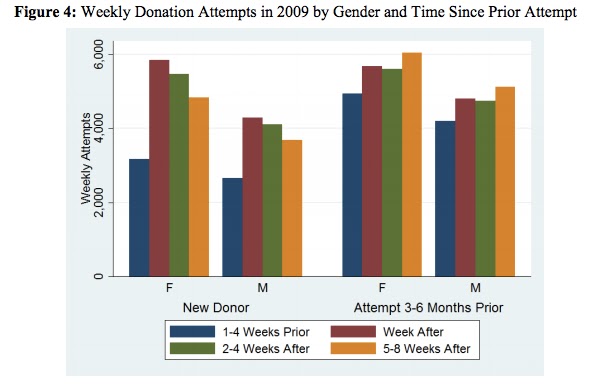
Bob Slonim tells me of a new paper of his: Matthew Lilley and Robert Slonim "Gender Differences in Altruism: Responses to a Natural Disaster," IZA DP No. 9657 January 2016

The abstract reads:
"High-profile disasters can cause large spikes in philanthropy and volunteerism. By providing temporary positive shocks to the altruism of donors, these natural experiments help identify heterogeneity in the distributions of the latent altruism which motivates donors. This study examines gender heterogeneity of volunteer response by blood donors following the most devastating Bushfires in Australia’s history. Using difference in differences analyses, we observe a sharp increase in blood donations after the 2009 Victorian Bushfires. Several key features of this increase are consistent with the predictions of a model where the distribution of latent altruism has smaller variance among women than men. First, the highest increase in donations occurs among previous non-donors, lapsed donors and less frequent donors. Further, the increase in donations following the Bushfires, compared to non-disaster periods, is substantially greater for females than males; the proportional increase in the number of females donating for the first time after the disaster is approximately twice the proportional increase for men. Notably, this gender gap decreases with the frequency with which people have previously donated. "

Here are some key figures:


and


Friday, January 29, 2016

poverty and economic decision making

There is a new paper in the AER this month on "Poverty and Economic Decision-Making: Evidence from Changes in Financial Resources at Payday,"by Leandro S. Carvalho, Stephan Meier, and Stephanie W. Wang, American Economic Review 2016, 106(2): 260–284

The abstract reads

"We study the effect of financial resources on decision-making. Low income US households are randomly assigned to receive an online survey before or after payday. The survey collects measures of cognitive function and administers risk and intertemporal choice tasks. The study design generates variation in cash, checking and savings balances, and expenditures. Before-payday participants behave as if they are more present-biased when making intertemporal choices about monetary rewards but not when making intertemporal choices about nonmonetary real-effort tasks. Nor do we find before after differences in risk-taking, the quality of decision-making, the performance in cognitive function tasks, or in heuristic judgments."

In their paper they replicate my paper with Ned Augenblick and Charles Sprenger (pp 270-272)

"Another way to disentangle the effects of economic circumstances on time preferences from liquidity constraints is to look at nonmonetary intertemporal choices. Augenblick, Niederle, and Sprenger (2015) argue that intertemporal choices about real effort are better suited than intertemporal choices about monetary rewards to capturing dynamic time-inconsistent preferences, because the latter are subject to several confounds. In the nonmonetary column of Table 3 we present subjects’ intertemporal choices between a shorter survey earlier and a longer survey later. We estimate an interval regression where the dependent variable is a measure of individual discount rate (as in Meier and Sprenger 2015).

We find that the two groups made similar intertemporal choices about a costly real-effort task: choosing between answering a shorter survey earlier and a longer survey later. In line with Augenblick, Niederle, and Sprenger (2015), both groups’ behavior was consistent with present bias: the implied monthly discount rate was  9  percentage points higher when the shorter-sooner survey had to be completed within 5 days (as opposed to 90 days).

However, there was no evidence of differential present bias between the before and after-payday group in the task when participants had to make intertemporal choices about real effort. Although one should be cautious in comparing intertemporal choices about monetary rewards to intertemporal choices about real effort (because discount rates may be domain-specific: see, e.g., Reuben, Sapienza, and Zingales 2010; Ubfal 2016), this result suggests that liquidity constraints may explain why the before-payday group behaved as if it was more present-biased in the monetary intertemporal choice task. "

Here is a pic of their main result: p 278


Notes: The bars show before-after differences for the following outcomes: expenditures (Study 2), present bias in intertemporal choices about money (Study 1), present bias in intertemporal choices about real effort (Study 1), risk aversion (Study 2), quality of decision-making measured in terms of violations of GARP and monotonicity with respect to FOSD (Study 2), memory span in working memory task (Study 1), and log of response time in numerical Stroop task (Study 2). The outcomes are scaled to comparable units by subtracting the median for the after-payday group and dividing by the median absolute deviation for the after-payday group. The height of the bar corresponds to the coefficient on the before-payday indicator variable in a regression of the outcome on the before-payday indicator variable and a constant. All regressions are OLS regressions with the exception of expenditures (median regression) and present bias effort (interval regression). In Stroop time, trial-specific dummies are included. The bands show 95 percent confidence intervals. Subjects = 2,496 (expenditures); 1,060 (present bias money); 1,025 (present bias effort); 1,119 (risk aversion); 1,119 (quality of decision-making); 1,038 (working memory); and 2,723 (Stroop time).


Summary of Main Results.—Figure 1 summarizes the main results (all outcomes are scaled to comparable units; see footnote of Figure 1 for more details). It shows that the before-payday group spent significantly less than the after-payday group. The before-payday group also behaved as if they were more present-biased when making intertemporal choices about monetary rewards, but not when they were making intertemporal choices about real effort. There are also no differences in the willingness to take risks, quality of decision-making, or in cognitive functioning.

Wednesday, January 27, 2016

Women and Chinese

My student David Yang pointed me to an interesting article that featured in the Chinese version of the NY times

"Enduring Prejudices of Gender Woven Into Chinese Language"
By DIDI KIRSTEN TATLOW December 4, 2015

The article starts with

"BEIJING — What if “womanwomanwoman” were the English word for rape, defilement, adultery? That is roughly how the Chinese character “jian,” or 姦, translates, as it is made up of three characters for “woman,” 女."

then

"“Why did one woman become three, and such a symbol of political and moral imagination and an object of enmity in traditional Chinese society and political theory?” asked Tong Yujie, the academic convener of the canceled exhibition, in an essay prepared for the show.
As evidence, Ms. Tong offered examples from ancient Chinese history and political texts:
• In the “Zuo Zhuan,” or “Commentary of Zuo,” dating from the fourth century B.C., “jian” is used to mean “evil”: “To cast away what is virtuous and give honor to what is evil is the greatest of calamities.”
• In the “Guoyu,” or “Discourse of States,” from the same period, a “jian” is a traitor: “Rebels inside the country are scoundrels, while those outside the country are traitors.”
"
and finally

"“In everyday language, how many Chinese speakers are aware that, in every set phrase with male-female gender reference, the male always comes first?” he said in an email.
“A married couple is 一对夫妇, a husband and wife. Your parents are your 父母, father and mother, never 母父, or mother and father. Even a phrase like 男女老少, meaning everyone, literally ‘men, women, old and young,’ subconsciously reinforces a supposedly ‘natural’ hierarchy — men over women, old over young,” Mr. Moser said."